
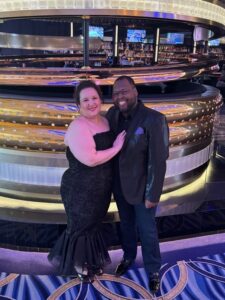
By Lindsay Marsh, Caregiver
When my husband Darnell was diagnosed with liposarcoma in January 2022, he had just turned 34 and we had been married for less than 18 months. Cancer was not on our radar. A rare cancer was definitely not on our radar. I remember feeling like we had been dropped into a world where everyone else knew the language except us.
From the beginning, humor became one of the ways we survived the fear. We jokingly named Darnell’s first tumor “DeAndre,” because somehow giving it a name made it feel a little less terrifying. At the end of February 2022, DeAndre was removed. It was too large to weigh in the operating room, and we later learned it was 27 pounds. Darnell’s surgeon, Dr. Malcolm Bilimoria, was able to remove it completely and save all of his organs. That outcome is something I will be grateful for forever.
What I will never forget are the 20 minutes I spent alone in a small hospital room waiting for Dr. Bilimoria to speak with me after surgery. Because of pandemic restrictions, it was one of the first times family members were allowed back in the hospital, and even then, access was still very limited. The surgery had gone much faster than expected, and in that waiting room, every possible version of our future ran through my mind. When Dr. Bilimoria arrived and began listing the organs he had been able to save, I realized something humbling: even though I work in healthcare consulting, I was still completely unprepared to know what questions I should have been asking.
“I also had to learn that caregiving is not only about doing. Sometimes it is about sitting in uncertainty, making room for fear, and still deciding what we are having for dinner.”
After surgery, Darnell completed preventative chemotherapy, and then our lives became measured in three-month increments. Every CT scan brought anxiety. Every good scan felt like we could breathe again. For three years, we received good news. We let ourselves hope that maybe this would become a chapter we looked back on instead of one we were still living.
Then the cancer came back.
I remember how quickly the ground shifted under us. One scan changed the tone of everything. The language changed. The questions changed. The way I listened in appointments changed. I became more aware of every pause, every word choice, every “we’ll keep an eye on it.” I remember how quickly the ground shifted under us. One scan changed the tone of everything. The language changed. The questions changed. The way I listened in appointments changed. I became more aware of every pause, every word choice, every “we’ll keep an eye on it.”
 Recurrence brought a different kind of fear than the original diagnosis. The first time, everything was shock and urgency. The second time, I knew too much. I knew what surgery meant. I knew what waiting felt like. I knew how long the days between a scan and a result could be. I knew how easily a normal Tuesday could become the day everything changed again
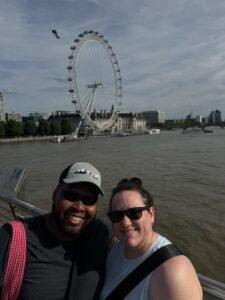
And because Darnell looks healthy, the experience can feel strangely invisible. He still looks like himself. He still makes jokes. He still goes to work, travels, and lives his life. To the outside world, he often looks fine. But caregivers know that “looking fine” and “being fine” are not the same thing.
That has been one of the hardest parts for me: learning to live in the space between gratitude and uncertainty. We are grateful for good care, grateful for slow growth, grateful for options, grateful for every good scan and every ordinary day. We are grateful to have each other. But we are also always aware that the next scan is coming.
My role as a caregiver has changed over time. At first, I was the person trying to organize appointments, understand terminology, take notes, and ask questions without falling apart. Over time, I became the keeper of timelines, scan dates, medication lists, insurance details, and the emotional temperature of our household. I have become more comfortable over time with the term “caregiver,” but it still does not feel completely accurate. Lately, I have been using “care partner.”
I am still walking beside him through every scan, every setback, every leap forward, and every uncertain stretch in between. We are in this together, even though our roles are different.
“What I wish more people understood is that caregivers live in the in-between. We are grateful and scared. Hopeful and exhausted. Strong and overwhelmed. We celebrate good news while bracing for the next scan. We want information, but not too much. We want support, but do not always know how to ask for it.”
My advice to a new caregiver is to write things down, ask the questions, accept help, and find doctors who understand rare cancers. Also, let yourself laugh. Humor does not mean you are not taking it seriously. Sometimes it is what helps you keep going.
For now, we continue to monitor closely with Darnell’s care team. We take things one scan, one appointment, one decision at a time. And in between, we try to live — really live — because if liposarcoma has taught us anything, it is that no time is promised.
Liposarcoma has changed our lives, but it has also shown us the power of research, specialized care, community, and love.